
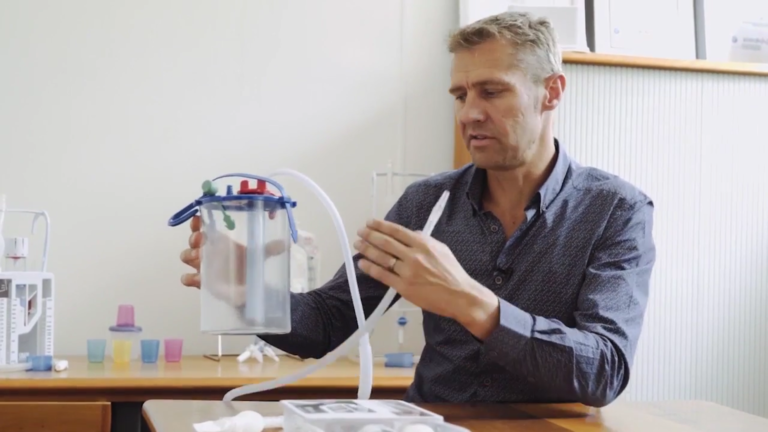
Innovation in healthcare plays a crucial role in saving lives and improving patient outcomes, especially in regions where specific medical challenges are prevalent. South African doctors have recently developed a groundbreaking device, the Sinapi Chest Drain, which has the potential to revolutionize the management of life-threatening wounds. This innovative technology, along with other African inventions, took the spotlight at the Innovation Effect Africa Conference held on May 2, 2017 in Durban, South Africa. The event aimed to showcase promising innovations, attract investments, and reinforce Africa’s position as a major contributor to global health technology development.
The Sinapi Chest Drain, developed by doctors at Sinapi Biomedical in South Africa, promises to enhance the treatment of critical wounds such as gunshot and stab wounds, as well as other traumatic injuries. Over a span of five years and after creating more than 1,000 prototypes, the medical professionals at Sinapi Biomedical successfully engineered a valve that effectively drains air, blood, and clots. Clinical trials have verified the safety and efficacy of the Sinapi Chest Drain, providing a significant advancement in wound management.
Chris de Villiers, the head of Sinapi Biomedical, shared his journey to a local South African publication named Times Live, stating, “In the end, it took five years and more than 1,000 prototypes to develop a valve that could drain air, blood, and clots and to prove through a clinical trial that it was safe to use on patients.” This remarkable achievement highlights the dedication and perseverance of South African medical innovators in their pursuit of improving healthcare outcomes.
The Innovation Effect Africa Conference served as a platform to showcase and promote innovative solutions emerging from Africa. The conference aimed to attract investments, strengthen Africa’s role in global health technology development, and highlight the continent’s potential in driving innovation. Ameenah Gurib-Fakim, the President of the Republic of Mauritius and a renowned biodiversity scientist, delivered the keynote address, emphasizing the critical role of science, technology, and innovation in Africa’s future.
The conference provided an opportunity to celebrate recent examples of African scientists, entrepreneurs, and innovators who are tackling local health challenges and contributing to economic growth. One notable innovation highlighted was a low-cost device designed to stop bleeding during childbirth, which is a leading cause of maternal deaths. Such initiatives demonstrate how African ingenuity is making a profound impact on healthcare outcomes and economic development in the region. Chris de Villiers, the head of Sinapi Biomedical, shared his journey to a local South African publication named Times Live, stating, “In the end, it took five years and more than 1,000 prototypes to develop a valve that could drain air, blood, and clots and to prove through a clinical trial that it was safe to use on patients.” This remarkable achievement highlights the dedication and perseverance of South African medical innovators in their pursuit of improving healthcare outcomes.
The Sinapi Chest Drain represents a remarkable achievement in medical innovation from South Africa. Its development exemplifies the perseverance and dedication of the doctors at Sinapi Biomedical, who spent years perfecting the device to save lives in cases of life-threatening wounds. The Innovation Effect Africa Conference provided a platform to showcase this and other African innovations, highlighting the continent’s potential in driving advancements in health technology. As Africa continues to invest in science, technology, and innovation, it paves the way for a prosperous future, where local challenges are addressed and economic development is fostered.